To get involved: email the Coquí Busters at coquibusters.mre@gmail.com or call Aaron Lisco at 808.868.6782.
For the map and more: see mauicoqui.com, an interactive coquí map of Haʻikū with a how-to guide and blog, built by a neighbor near Māliko Gulch.
🐸 Coquí Frogs: A Neighborhood Effort Is Under Way
The coquí is a small frog, native to Puerto Rico, with a very loud, piercing, two note call, co-KEE, that it repeats through the night. A dense infestation is not a background sound, it is a wall of noise that carries through closed windows and takes away the quiet that most of us moved up here for. Coquí have been established on Maui for roughly twenty five years, and Haʻikū holds the island’s largest population.
Coquí in Hawaiʻi reach higher densities than any land dwelling amphibian anywhere else in the world, two to three times what they reach in their native Puerto Rico. The Maui Invasive Species Committee (MISC, mauiinvasive.org) divides Haʻikū into management zones. Zone 1, the red zone around Māliko Gulch, is so heavily infested that since mid July MISC no longer sends crews to treat homes there, though it still supplies citric acid and training to residents who do the work themselves. Maui Ranch Estates is in Zone 2, the threatened area, and we sit on its eastern frontier. East of us is East Maui Irrigation land and other open country. MISC’s highest priority is keeping coquí out of East Maui, where an infestation could become impossible to manage. Clearing our neighborhood helps protect it.
🌴 MISC and Resident Efforts
MISC has fought the frogs here since the beginning, but with its crews no longer treating homes in the most heavily infested part of Haʻikū, it is concentrating what is left of its capacity on stopping the spread into new areas. That is a defensible choice, and it means the work in our neighborhood now falls to the people who live here. A lesson from other Maui neighborhoods is that working alone does not hold ground: frogs do not respect property lines and will move back in from an untreated lot next door. To this end a group has organized across the neighborhood to deal with our local infestation. Neighbors on adjacent streets outside the HOA are welcome, and the effort will not succeed without them.
📍 Where the Frogs Are Now
The heaviest infestation in Maui Ranch Estates is at the end of N. Lanikai, moving up the eastern gulch toward S. Lanikai, and moving over to Kapuai Rd. They have crossed Kapuai and are working their way toward Waipalani Rd. The goal is not just to stop them spreading further west and south. It is to push them back and out of our neighborhood, and to help our neighbors beyond the HOA do the same.
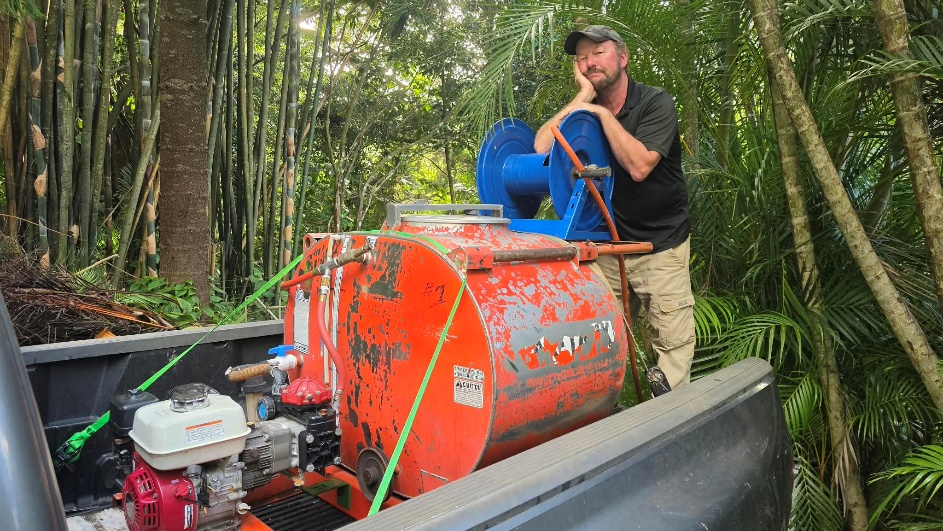
Todd Johnson feeling tankful for MISC’s sprayer.
🌱 Why Coquí Matter Beyond the Noise
Coquí do more than keep us awake. They interfere with natural cycles and help other invasive species spread, from mongoose to weedy trees, and they carry parasites. Their waste enriches Hawaiʻi’s naturally poor volcanic soils, favoring invasive plants over natives; strawberry guava puts out more new leaves where coquí are present. Frogs can also carry rat lungworm, which causes a serious disease in people and pets: a 2020 study found it in 21 of 24 coquí tested in Hilo. Keep pets from eating frogs, and wash your hands after catching them. Every frog removed helps.
Further reading
Maui Invasive Species Committee,
“Coquí frogs negatively affect the environment in more ways than one,”
Kiaʻi Moku column, The Maui News, February 10, 2019.
Serene Gunnison,
“Maui Animal of the Month: Coquí Frogs,”
Maui Guide. A general introduction for readers new to the frog.
Sin, Beard and Pitt (2008),
“An invasive frog, Eleutherodactylus coqui, increases new leaf production and leaf litter decomposition rates through nutrient cycling in Hawaii,”
Biological Invasions 10:335–345.
Hall, Huber and Hughes (2018),
“Invasion of Hawaiian rainforests by an introduced amphibian predator and N2-fixing tree increases soil N2O emissions,”
Ecosphere 9(9): e02416.
Beard, Price and Pitt (2009),
“Biology and impacts of Pacific Island invasive species. 5. Eleutherodactylus coqui, the coquí frog,”
Pacific Science 63(3):297–316.
Niebuhr et al. (2020),
“Occurrence of rat lungworm (Angiostrongylus cantonensis) in invasive coqui frogs (Eleutherodactylus coqui) and other hosts in Hawaii, USA,”
Journal of Wildlife Diseases 56(1):203–207.
University of Hawaiʻi at Hilo,
Rat Lungworm Overview.
💪 What Can I Do?
First and foremost, start by reducing their habitat in your own yard (see MISC’s Make your yard less frog-friendly). Clear accumulated ground litter, especially fallen palm fronds, where the frogs shelter by day, and thin dense growth such as areca palms, ti, ginger and bromeliads, so fewer frogs can hide and spray reaches the ones that remain. If you are able, consider buying your own sprayer, since coquí take repeated treatment and your own equipment lets you work your lot whenever you need to. If you need training in hand catching or spraying, come to one of the group’s meetings and someone will walk you through it. If you are already treating your property, keep going, and if you have been thinking about starting, now is the time.
And join with your neighbors. Coquí control works best when teams work together. Join our work parties!
🤝 Coquí Busters
Aaron Lisco, a resident at 60 Kapuai, has volunteered to lead the effort, which is calling itself the Coquí Busters. The group has begun meeting to compare notes on what actually works here and to plan coordinated work. They are requesting help from the community. Owners and renters can both pitch in.
If you are fighting frogs on your lot, or are willing to start, get in touch with the group directly.
Coquí Busters
coquibusters.mre@gmail.com
Aaron Lisco
808.868.6782
🔑 Landowners Will Be Asked, and Can Say No
Because the frogs cross property lines, the group will need to work across neighboring parcels. Nobody will enter your property without your permission. If you are willing to have the group work on your land, say so. You can set limits on where and when, and you can withdraw permission at any time. If you would rather they did not, that is ok, and it helps to know, so the group can plan around your lot.
If you are wondering about your own liability for letting volunteers onto your land, Hawaii law addresses this directly. Chapter 520A of the Hawaii Revised Statutes, Landowner’s Liability for Access to Control Invasive Species, limits the duty of care an owner owes to someone permitted onto the property to control or eradicate invasive species. It applies where the owner permits the access without charge, which is the case here. The protection is not unlimited. It does not cover willful or malicious failure to warn about a dangerous condition on the property that the owner knows about. If you have a hazard on your land, tell the group about it before they come.
🌿 How the Work Is Done
The standard treatment is a citric acid solution sprayed on frog habitat, and spraying by day is highly effective. Catching them by hand works too, and a 365nm UV light is highly effective for finding them, because their eyes shine back at you. MISC provides the acid powder at no cost.
Caution: the citric acid solution is a severe eye irritant and a moderate skin irritant. It is not hazardous the way a pesticide is, but it is not harmless either. Wear eye protection, gloves, long sleeves and long pants while spraying. If you are working where someone has recently sprayed, wear gloves and let the foliage dry before handling it. Follow the guidance that comes with the equipment, especially directions to rinse the corrosive acid from the machine.
MISC has not walked away from residents, it has changed what it does for them. Through its Community Coquí Control Program it offers training, premixed citric acid solution, and sprayers on loan, from backpack units up to larger ones. The labor and the transportation are ours. MISC is stretched thin and some of its equipment is out of service, so what is available on any given week is worth asking about rather than assuming.
Information on MISC’s efforts, including video demonstrations, is at MISC’s Community Coquí Control Program page. Be aware that this page may contain outdated information about MISC’s ability to assist.
For background on where things stand across Haʻikū, see “Haʻikū residents urge more action against coquis,” The Maui News, August 6, 2026.
🏠 Where the Association Stands
This is a neighbor led effort, not an Association program. It deliberately includes households outside the HOA, as the frogs do not stop at the subdivision boundary and neither can the response.
At its August 5 meeting the Board heard Aaron’s presentation and was supportive. At its September 17 meeting the Board voted unanimously to fund the group’s equipment, including two large sprayers, which are essential to the spray effort. The equipment belongs to the Association.
🔒 On Privacy
The Association does not share your name, address, phone, or email with other residents or with outside parties without your permission. The Coquí Busters email above is a group address, and Aaron’s phone number appears because he asked that it be published. If you would like to be connected with neighbors working on this and would rather not reach out yourself, let the Board know and we will pass a message along. We do not hand out contact lists.
📝 Sign Up
If you hear a coquí on your property and cannot get rid of it on your own, the Coquí Busters will put you on the schedule. Use the link below and tell us your name, your address, and how to reach you. You can use the same link to volunteer, to ask for training, or to give the group permission to work on your land.
You can also write to coquibusters.mre@gmail.com yourself, or call Aaron Lisco at 808.868.6782.
Sign up by email🗺 The Map and More
Neighbors across Haʻikū keep an interactive coquí map at mauicoqui.com. Roads are shaded where people have heard frogs calling, and where they listened and heard none, and owners can mark their own lot as being worked on or needing help. You can add a report from your phone without an account. The site also has a practical how-to guide and a history of the fight around Māliko Gulch, and a blog with news and answers to common questions, such as what to do when you hear a coquí in your own yard.
It is an independent project built by a neighbor, not run by MISC or the Association, and marking a frog on the map does not send anyone out. For help on your own lot, contact the Coquí Busters above.